


How to Apply
Applying ESN To Your Crops
ESN technology protects your nitrogen investment by reducing losses from leaching, volatilization, and denitrification—helping ensure your crop receives nitrogen when it needs it most.
Select your crop below to see tailored application rates, timing, and placement recommendations.


Every type of nitrogen fertilizer is applied and handled differently. These general use recommendations for ESN are based on optimal growing conditions. Your specific conditions and goals should be considered to achieve best results. Always ask your retailer for recommendations.
Use in Canola
Proper nitrogen (N) nutrition of canola is critical to high yields and overall plant health. Nitrogen is essential for vegetative growth, yield and protein synthesis. Nitrogen is a critical component of the photosynthetic factory that converts solar energy to proteins, starches, and oil. Excess N early can cause excessive vegetative growth and lodging. Excess vegetative growth can also deplete soil moisture leading to greater moisture stress during grain fill. Controlling the rate of N supply with ESN can help increase N-use efficiency by protecting most N from loss until the period of rapid crop uptake.
Interactions of weather conditions, timing of N demand, and potential for N loss should be considered in determining the most appropriate ESN application or blend of ESN, for different geographies and uses.
Canadian Prairies and Upper Northern U.S. Tier States
Nitrogen management presents numerous challenges. Crops require relatively high N rates, but most of the N fertilizer is applied in advance of peak crop demand. Precipitation during fall and winter, and especially during early spring, produces potential for N loss by leaching and denitrification. ESN provides greater protection against N loss as compared to conventional N sources.
Spring Application
- Pre-plant band, side/mid-row band.
- Pre-plant broadcast and incorporated.
- Seed row placed – ESN provides a physical barrier between the seed and the urea within the coating. As such, greater seed row safety can be achieved when using ESN as opposed to urea or ammonium sulphate nitrogen sources. Within the Canadian Prairie provinces – safe rate guidelines exist for nitrogen placed with the seed, on the provincial agricultural websites. ESN can be used at 3X indicated rates when it is 100% of the N source, ESN can be used at 2X the existing safe rate when it is 70% of the N source and at 1.5X the safe rate indicated, when it is 50% of the total N source.
- Pre-plant broadcast unincorporated, using the seeding operation for incorporation.
- Crop residue is necessary to hold ESN in place (broadcast applications).
- Heavy crop residue may restrict ESN – soil contact, and potentially affect N release from ESN due to poor ESN to soil moisture contact.
- Post-emergent application may result in delayed N availability from ESN, as it relates to crop N uptake demand for annual spring seeded crops.
- For early spring ESN applications, ESN provides greater protection against N loss, as opposed to conventional N sources applied at the same time.
- Under average conditions in these areas, 35 – 50% of ESN-N will be released in 25 to 30 days after application. The balance of ESN-N will be released over the following 30 to 40 days.
- Impregnating crop protection chemicals on ESN has not been evaluated.
Fall Application
- Band applied
- Broadcast and incorporated
- Broadcast un-incorporated
- Crop residue is necessary to hold ESN in place (broadcast applications)
- Heavy crop residue may restrict ESN – soil contact, and potentially affect N release from ESN due to poor ESN to soil moisture contact
- Under average conditions for these areas, ESN-N will release N in the urea form; N will either be encapsulated in the urea form and/or in the ammonium – N form going into fall freeze-up
- At spring-time ESN-N will be releasing N in the urea and ammonium N forms; the earlier released N (ammonium) will be undergoing conversion to nitrate-N forms
- ESN research in Melfort, SK (Malhi, AAFC) has shown that fall band applied ESN out-yielded fall band applied urea for canola production
- Under average fall application conditions for these areas, ESN is expected to release between 35 and 50% if its N in the urea form, over 60 days, as the soil temperature drops from 10C to frozen soil condition
- Conversion of urea to ammonium (and potentially nitrate) is dependent upon application timing
Seed Safe Rates
The following are considered to be approximate safe rates of urea (46-0-0) N applications if seedbed soil moisture is good to excellent (soil moisture at or near field capacity).
Applying ESN to Canola
All rates are in pounds actual N per acre (i.e. divide by 0.46 to get lb. of 46-0-0 per acre).
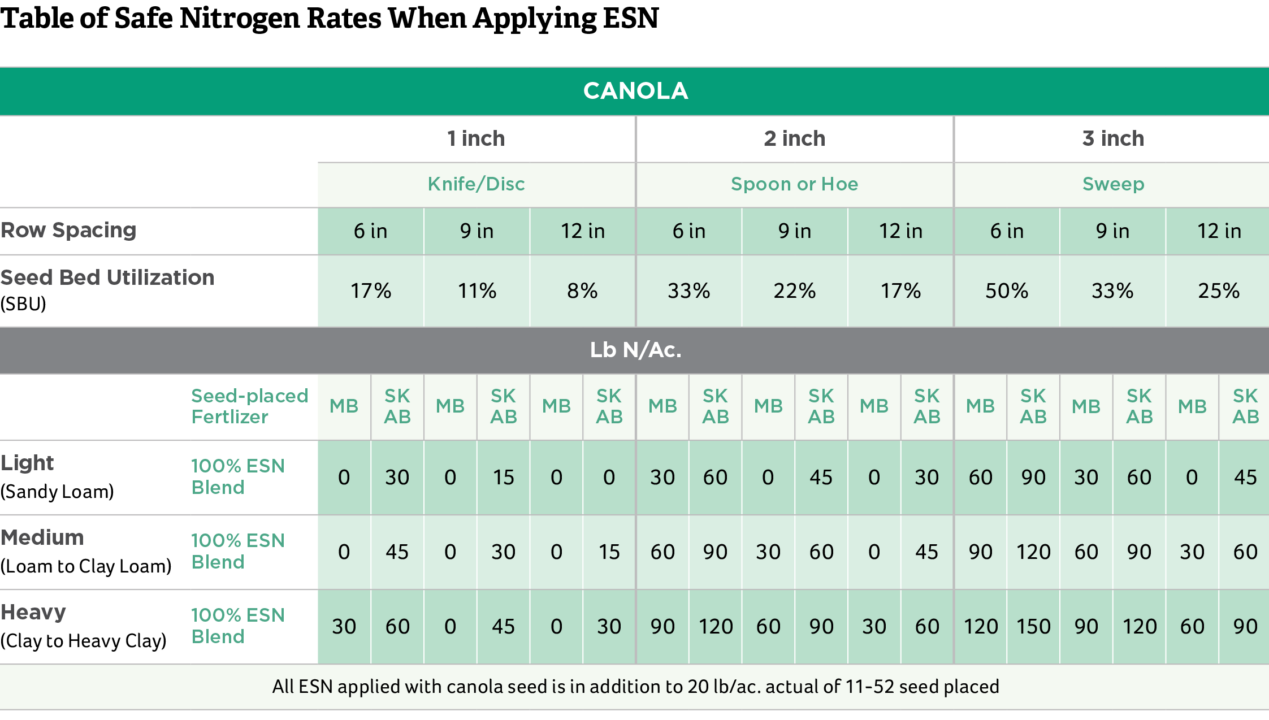
*Lb N/ac. of N as ESN shown to be safe when applied with the seed. Based on 2x‐3x the safe rate of urea applied to cereal grains. Values are representative. Make sure to check the local seed safe rates for your geography and crop or contact an ESN marketing rep for more information. **The width of spread of fertilizer and seed depends on the type of opener, soil type and moisture content, air flow, etc. Some openers give less than 1″ spread (e.g., double disc). ***Recommended rates are based on proper handling of ESN. Visit www.SmartNitrogen.com for ESN handling recommendations, which can impact the seed safety characteristics of ESN.