Agriculture Plays a Key Role in Your Favorite Holiday Traditions
Christmas is a time for reflection and gratitude. We’re grateful for our friends, family, employees, and customers for their support throughout the year, and for farmers’ contributions to some of our favorite holiday treats. In addition to the item’s we enjoy at both Thanksgiving and Christmas dinner, here are a few ways agriculture takes the spotlight at Christmas time:
Candy Canes
The first candy canes were not cane-shaped, but straight, only white – not striped, and flavored with sugar. According to legend, a German choirmaster bent the white sugar sticks to look like a shepherd’s hook. The first example of using candy canes to celebrate Christmas is from Wooster, Ohio in 1847 when August Imgard decorated his Christmas tree with paper ornaments and candy canes. The red striping and peppermint flavor appeared at the turn of the 19th century.
The U.S. produces over 70% of the world’s peppermint and spearmint. Peppermint is mostly grown in Oregon, Washington, Idaho, Indiana, California and Wisconsin. As far as total mint production in Canada, Alberta leads the way.
Eggnog
This is either a love or hate thing. Drinking eggs, unless you’re Rocky, doesn’t sound very appealing. Eggnog, according to Merriam-Webster, was first used around 1775. So, the word “eggnog” might be an American invention, but probably had English influence.
The U.S. produces around 99 billion eggs each year with Iowa, Ohio, Indiana, Pennsylvania and Texas as the top egg states. Ontario produces the most eggs in Canada followed by Quebec, British Columbia and Manitoba. Canada produces around 650 million dozen eggs per year.
What do you mix with it? If it’s bourbon, Kentucky produces 95% of the world’s supply of bourbon and to make bourbon, you need corn.
Gingerbread
The popularity of gingerbread in Christmas can, at least in part, be attributed to the belief that spices heat you up in the winter.
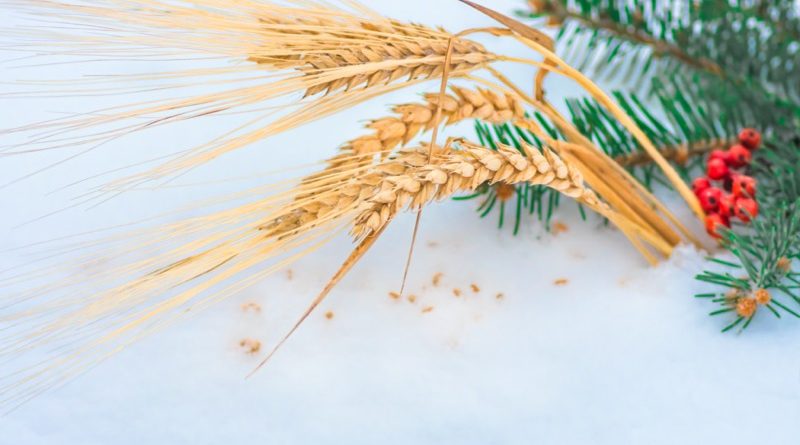
The U.S. produces around 1.884 billion bushels of all types of wheat with Kansas, North Dakota, Washington, Montana and Oklahoma leading the way. Of the estimated 9,953,300 hectares of all types of wheat grown in Canada, Saskatchewan, Alberta and Manitoba produce the most wheat.
Ginger and cinnamon are mostly imported into the U.S. and Canada, although ginger is grown in Hawaii and Georgia.
So remember, just about everything you use at Christmastime has agricultural roots, including the wrapping paper, Christmas ham, and bad Christmas sweaters. They’ve all needed a farmer to make sure our families have fond memories that last a lifetime.