

Managing Nitrogen in the Field – 4R Best Practices
Nitrogen can be a costly and difficult to manage nutrient in your fertilizer …
Nitrate Concentration in Suction Lysimeters
This study comes from a potato grower’s field, which was split in half. Half of the circle was fertilized with ESN at planting; the other half was fertilized with a conventional program consisting of pre-plant urea plus the bulk of the required nitrogen (N) applied thru the center pivot with irrigation water on a regular basis (total of eight fertigation applications). Suction lysimeters are a device used to extract the soil solution for the purpose of measuring soluble nutrients and other elements that are in the soil. When placed at different depths in the root zone, they are useful for monitoring the downward movement of mobile nutrients such as nitrate-nitrogen. The conventional program of ‘spoon-feeding’ N thru irrigation has been demonstrated to be an excellent N management practice as long as irrigation is properly managed. In this case, a single application of ESN with one supplementary fertigation resulted in less leaching loss plus saved the grower time and money, increased yields, and improved crop quality, a very attractive value package for the grower.
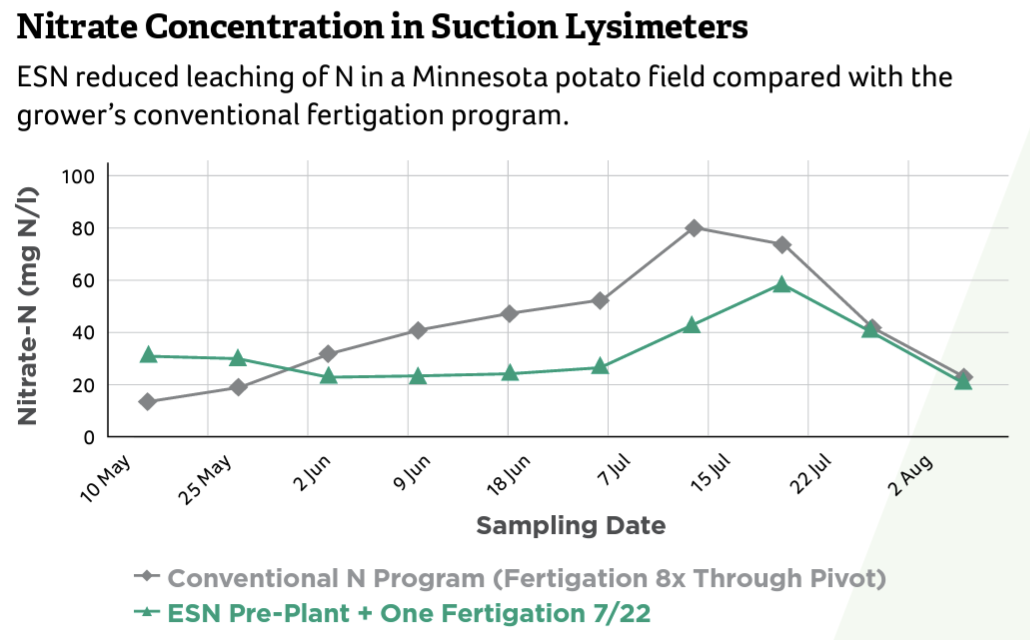 Figure 1. ESN reduced leaching of N in a Minnesota potato field compared with the grower’s conventional fertigation program.
Source: Dr. Carl Rosen, University of Minnesota
Nitrogen Leaching on Winter Wheat, Ohio
This study measures actual water drainage from the root zone and N lost in the drainage water. In this study, each plot (100 x 30 feet) is drained individually. Drainage tiles collect soil water and pass it thru flow meters where samples are taken to measure the concentration and volume of water passing below the root zone. The total amount of N lost is calculated from the volume and concentration. Fertilizer treatments were broadcast on winter wheat in early April. From the graph, one can see there is no difference in N leaching until fertilizer is applied, after which one can see the impact of heavy rains in May on N loss. Note that N leaching from ESN is significantly less than urea or UAN.

Figure 2. An Ohio drainage study measures shows the impact of rainfall and N source on N lost by leaching from topdress N applications on winter wheat.
Source: Dr. Rafiq Islam, The Ohio State University
| Attachment | Size |
|---|---|
| ESN Reduces Nitrogen Loss to the Environment | 1.85 mb |
Nitrogen can be a costly and difficult to manage nutrient in your fertilizer …

Efficient nitrogen (N) management is an important driver of yields and profitability. However, …

When you add nutrients to your soil, it’s not just your crops that …