Managing Nitrogen in the Field – 4R Best Practices

Nitrogen can be a costly and difficult to manage nutrient in your fertilizer program. A farmer needs to maximize uptake efficiency of nitrogen fertilizer to prevent loss and maximize potential crop yield. Every pound of nitrogen lost, through leaching, gaseous ammonia losses or emissions related to denitrification or erosion, will reduce a crop’s yield potential while posing a potential risk to the environment. Protecting nitrogen fertilizer from loss, increasing its efficiency and properly managing it is essential to profitable and sustainable crop production and nutrient management.
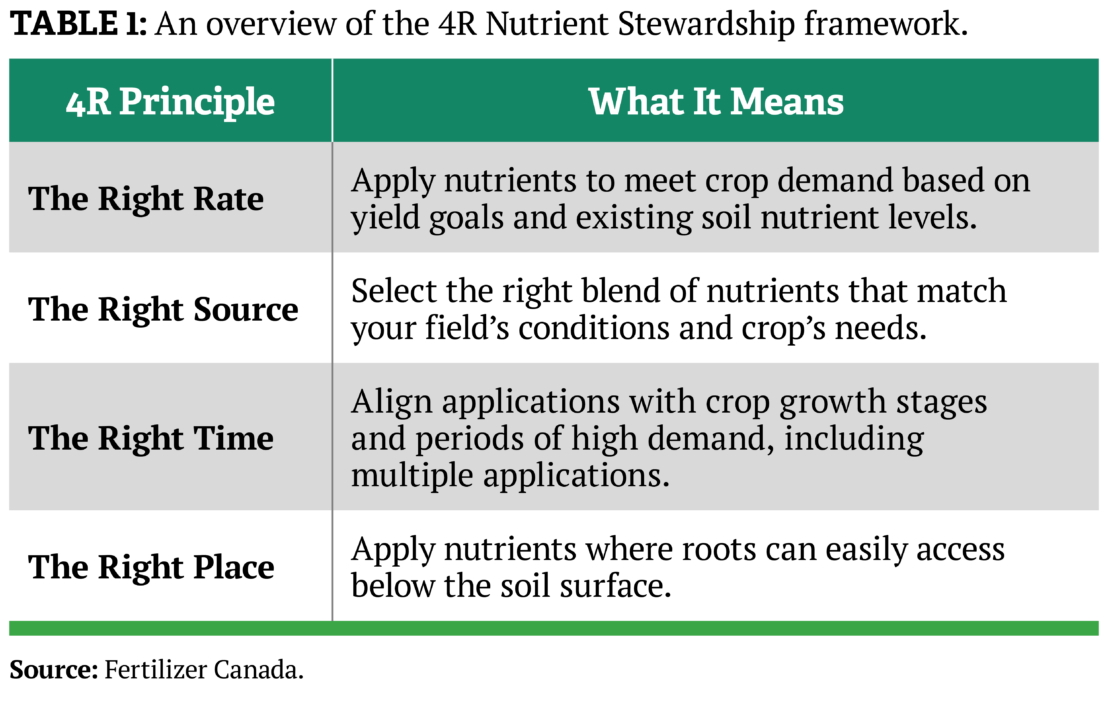
The 4Rs of nutrient stewardship can help you accomplish these goals by using the right source of nitrogen at the right rate, at the right time and in the right place (see Table 1). The framework is designed to help you align your nitrogen fertilizer inputs and nitrogen supply with the requirements of your crops to help minimize losses and increase uptake.
While every farm and every field are different, there are best management practices that can help guide your 4R approach. A recent report from Fertilizer Canada breaks down current practices for fertilizer use in Canada and highlights how producers are implementing the 4Rs across their operations. This article will help you explore the key nitrogen insights shared in Fertilizer Canada’s 2023 Fertilizer Use Survey report and how you can implement the 4Rs in your nitrogen fertility program.
The 4R Framework
The goal of the 4R framework is to match your nutrient applications with the needs of your crops to minimize nutrient loss and increase uptake. These practices help you achieve your production, profitability and sustainability goals while protecting the environment from the repercussions of nutrient loss.¹ Examples of the 4Rs are outlined below (Table 1).
4R Nutrient Stewardship is more than a framework. It’s a science-based strategy that helps you maximize fertilizer efficiency, improve ROI, boost crop performance and protect the environment through your fertilizer program.
Let’s take a closer look at best practices and trends in nitrogen management that can help you put the 4Rs into action in your operation.
Trends: The Right Rate
Applying the right rate of nitrogen fertilizer means matching fertilizer applications to a crop’s nutrient demands based on soil nutrient levels, predicted yield and environmental conditions and risks. This allows you to maximize plant uptake while reducing nitrogen loss through leaching, volatilization, denitrification and erosion.
The right rate of nitrogen will depend on your specific crop, soil conditions and location. The 2023 Fertilizer Use Survey report found that potato and grain corn growers applied higher nitrogen rates due to the demands of their crops, with an average nitrogen application rate of 116 pounds per acre in the spring at planting for potatoes and 159.4 pounds per acre in the spring at planting for grain corn.¹ These rates serve as a benchmark for growers producing these crops, however; you will optimize your own rates based on your region, soil test results and agronomic goals.
Soil testing is the most common way that you can determine the right rate of nitrogen needed in your fields. It gives you a comprehensive look at the nutrients available in your soil and the need for nitrogen across your fields.³
The 2023 survey report found that growers test soil for both nitrogen and phosphorus every three years in order to track removal, uptake and efficiency over time. While this timeline is effective, some growers choose to soil test for nitrogen every year to more accurately determine the right rate to apply in their annual fertilizer programs.¹
Soil testing allows you to optimize your nutrient application rates and, in turn, not only reduce cost on inputs, but also reduce the potential for nutrients to be lost to the environment. Frequent and targeted soil tests can be a helpful tool for many farms to adopt as they look to improve the right rate of fertilizer.
Trends: The Right Time
Fertilizer application timing is essential to minimizing nitrogen loss and increasing uptake. It’s all about supplying the nitrogen your crops need, when they need it, by aligning application timing with periods of high demand, considering factors like crop development, growth stages and environmental conditions.
The right time to apply nitrogen in Canada is typically in the spring at planting for most crops.¹ This application timing allows you to meet the demand of your crops all season long while reducing nitrogen losses. In some regions, late fall applications of nitrogen fertilizers can be effective when carefully applied and managed.
Topdressing a portion of your nitrogen fertilizer mid-season can also be an effective application for longer-season crops such as potato and corn.
Trends: The Right Place
The right place ensures that crops can easily access the nutrients you apply for uptake. For most nitrogen fertilizer applications, the right place is in a subsurface band placed at least three inches under the soil surface.
For crops that can benefit from the mid-season top dressing of nitrogen fertilizer, the right place will be through side dressing or fertigation.
Trends: The Right Source
While the right source of nitrogen varies for each crop, the survey noted an emerging trend across every crop type – the increased use of enhanced efficiency fertilizers (EEF). EEFs are fertilizers that are designed to reduce nutrient losses to the environment and increase nutrient availability to crops. They either slow the release of nutrients for uptake (slow release and controlled products) or alter the conversion of nutrients into forms that are less susceptible to loss (inhibitors or stabilizers). Ultimately, they help growers increase nutrient efficiency and reduce greenhouse gas emissions without sacrificing yield.²
The 2023 Fertilizer Use report found that 27 percent of the nitrogen applied to surveyed potato and grain corn acres in Canada was applied using an EEF – from polymer coated urea products like ESN to nitrogen stabilizers and inhibitors. EEFs are a natural fit within the 4R framework and help growers better align the release of nutrients with periods of high crop uptake while reducing losses, maximizing productivity and increasing their ROI. ESN is a primary example of an EEF that can help growers see up to 10 times their return on investment while reducing nitrogen losses and maximizing uptake.
The Value of Enhanced-Efficiency Fertilizers
Using an EEF in combination with your primary nitrogen fertilizer is also a common 4R practice. The 2023 Fertilizer Use Survey report found that surveyed grain corn producers treated the greatest number of acres using a nitrogen stabilizer in combination with their nitrogen fertilizer – a best management practice for reducing nitrogen loss by slowing down nitrogen conversion in the field. Corn’s long growing season and growth under high levels of irrigation or rainfall make it an ideal crop for getting the most value out of EEFs.
EEFs represent a practical and innovative step forward in helping you meet your profitability and productivity goals while creating more sustainable fertilizer programs across the country.
Looking Ahead
While nitrogen fertilizer can be a costly investment, better nitrogen management practices can reduce the risk of loss and maximize crop yield response to nitrogen fertilizer. Implementing 4R practices can help you maximize nitrogen uptake and reduce nitrogen loss while meeting your production, profitability and sustainability goals. While every field is different, these best practices can help you begin exploring how you can implement the 4Rs in your operation and reach your agronomic and environmental goals season after season.
We recommend that you start by assessing your current nitrogen program and identify where you can align more closely with the 4R principles. Whether it’s making a slight adjustment to your application timing, soil testing more frequently or adopting an EEF like ESN, small changes can make a big difference in the profitability, productivity and sustainability of your nitrogen fertility program.
Explore how ESN and the 4R approach can work for your operation with the resources below:
4R Nutrient Stewardship Program Shares Data to Prove Value to Farmers
How Growers Are Implementing The 4Rs With ESN
Precision Ag: The Key to Making it ‘Just Right’ With the 4Rs
Sources:
Fertilizer Canada. (2023). 4R in Canada: A National Overview – 2023 Fertilizer Use Survey. https://fertilizercanada.ca/our-focus/stewardship/fertilizer-use-survey/
Agriculture and Agri-Food Canada. (2022). Living Lab – Atlantic Research Solidifies Enhanced Efficiency Fertilizer as a Win-Win for Farmers and the Environment. Government of Canada. https://agriculture.canada.ca/en/science/story-agricultural-science/scientific-achievements-agriculture/living-lab-atlantic-research-solidifies-enhanced-efficiency-fertilizer-win-win-farmers-and
Government of British Columbia. (2024). Agriculture soil and nutrients – soil and nutrients for crops. https://www2.gov.bc.ca/gov/content/industry/agriculture-seafood/agricultural-land-and-environment/soil-nutrients