Balancing Nitrogen, Crop Production Goals and the Environment

Efficient nitrogen (N) management is an important driver of yields and profitability. However, nitrogen is highly susceptible to loss through several pathways including leaching, volatilization and denitrification.
These losses not only diminish yield potential and reduce growers’ return on investment, but also pose environmental risks to the air, water and soil. To address these challenges, researchers are continuously refining nitrogen management practices that can improve nitrogen-use efficiency and enhance grower outcomes.
A recent study conducted by Dr. Fabian Fernandez and his team at the University of Minnesota evaluated various nitrogen management techniques to offer practical insights that can support both yield and profitability goals.
Study Overview
The study was conducted at the University of Minnesota’s Southwest Research and Outreach Center to determine how various nitrogen management techniques affect crop response, economic returns of corn and nitrogen loss to the environment. The field experiment compared four nitrogen treatments on a continuous-corn rotation from 2018-2020. The four treatments (applied at 180 total pounds of nitrogen per acre) included:
- Simple Urea Treatment (U): A single pre-plant application of urea.
- Simple ESN Treatment (ESN): A single pre-plant application of ESN.
- Advanced Urea Treatment (U/U+): Split application of 60 pounds of nitrogen per acre as urea pre-plant and 120 pounds of nitrogen per acre top-dressed as urea+NBPT [N-(n-butyl) thiophosphoric triamide] at V6.
- Advanced ESN Treatment (ESN/U+): Split application of 60 pounds of nitrogen an acre as ESN pre-plant and 120 pounds of nitrogen per acre top-dressed as urea+NBPT [N-(n-butyl) thiophosphoric triamide] at V6.
ESN, included in the study, is a polymer-coated, controlled-release nitrogen fertilizer that reduces the risk of nitrogen loss by releasing nitrogen at a rate controlled by soil temperature; providing a continuous nitrogen supply to crops, while reducing exposure of fertilizer nitrogen to loss.
Urease inhibitors were also included in split application treatments. NBPT was added to urea for V6 top-dress treatments to reduce the volatilization potential of surface-applied urea.
Crop yields, nitrogen uptake, and nitrogen lost by nitrate (NO3) leaching, nitrous oxide (N2O) emissions and ammonia (NH3) volatilization were measured for each of the four treatments, and economic returns were determined.
Study Results
The study demonstrated a strong connection between nitrogen treatment performance and rainfall patterns during the growing season. Notably, most nitrogen loss was traced back to a handful of significant rainfall events, showing how weather conditions can affect efficient nitrogen management.
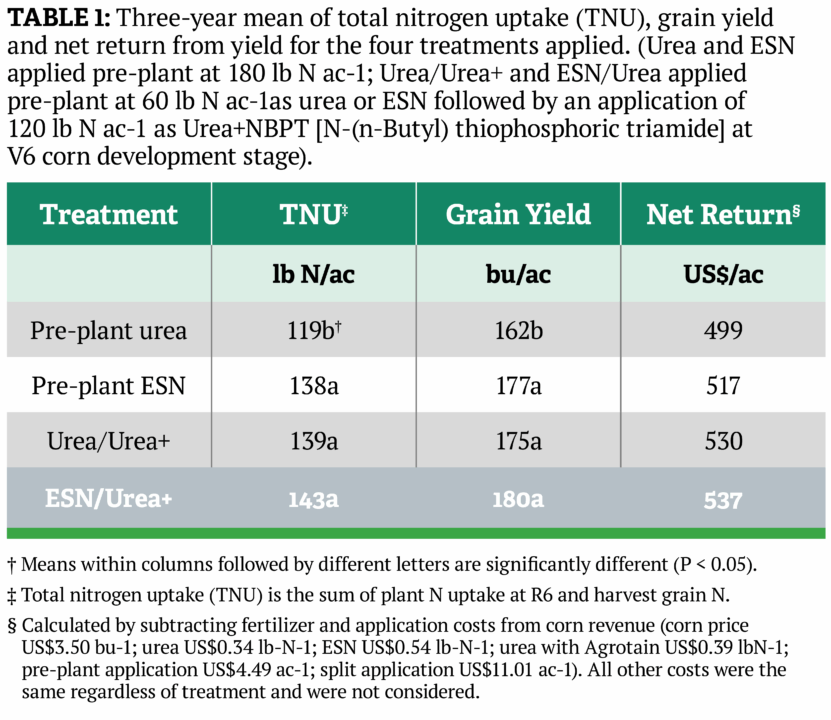
Advanced nitrogen management techniques, including the use of enhanced-efficiency fertilizer products like ESN, had a clear performance advantage in this study. Among all treatments, pre-plant ESN applications generally had the lowest nitrogen losses. Pre-plant ESN and split applications produced similar average total nitrogen uptake and corn yield, indicating strong performance in the field regardless of rainfall patterns (see Table 1).
The least efficient treatment in the study was a single pre-plant urea application, resulting in lower average yield than pre-plant ESN and split applications and greater nitrogen losses than pre-plant ESN. While urea may have lower upfront costs, a single application of ESN increased overall net returns by US$18 an acre over pre-plant urea. Split-application strategies produced even greater value, generating $38 an acre more than pre-plant urea when including ESN and $31 more when using just urea and urea plus Agrotain. In total, pre-plant ESN was able to lower the loss of nitrogen through leaching, volatilization and denitrification by 47-49% compared to all other treatments (U, U/U+ and ESN/U+).
Nitrogen Management
Proper nitrogen management in the field is key to reducing nitrogen loss, improving fertilizer-use efficiency and meeting crop production goals. Unpredictable field conditions can make it challenging to meet nitrogen-management goals as the ability to forecast weather conditions is limited. However, the results from this study show that implementing best management practices (BMPs) and advanced fertilizer technologies like ESN and nitrogen stabilizers can help growers achieve better nitrogen-use efficiency. While split applications are typically considered a BMP for corn growers, enhanced fertilizer technologies can improve the performance of such BMPs.
The Power of ESN
This University of Minnesota study corroborates the benefits of ESN shown in other research across the Corn Belt over several decades. When used in conjunction with proper timing, placement, and rates, ESN can help you maintain your farm’s productivity and profitability while lowering nitrogen loss and protecting the environment. With no additional equipment needed, it’s easy to implement on every farm. Dig into additional findings on the North Central Extension-Industry Soil Fertility Conference proceedings page.
Explore a detailed report on the full study here.
To learn more about how ESN has helped growers reduce nitrogen loss, increase yield, drive productivity and maximize profitability, visit the following resources:
ESN Increases Corn Yield for Winning Team
ESN Produces Greater Yields and Profits in Kansas Corn
What Value Do Enhanced-Efficiency Fertilizers Offer to Growers?
Practical Tips for Spring Planning and Nitrogen Management
Nitrogen Management: How Nitrogen is Lost and How to Protect It
Minimize Nitrogen Loss by Applying ESN
Choosing Enhanced Efficiency Nitrogen Fertilizer Products | ESN