ESN: The Seed-Safe Nitrogen Fertilizer Choice
Your seeds have maximum yield potential when put in the ground – from there, it’s up to your management and mother nature to maintain that potential. When placing nitrogen with seed, ensuring your fertilizer source won’t damage or set back your seeds is a key part of that equation.
Don’t risk damage and nitrogen loss
Many nitrogen sources, like anhydrous ammonia, carry a large risk of seed damage and require a significant waiting period between seeding and application. There is no exact safe waiting period following ammonia injection, and injury may occur even when planting several weeks after application if injection is too shallow. Research has shown that corn planted on ammonia injection bands was susceptible to stand loss, root pruning, and/or stunting if ammonia was injected less than 8-10 inches deep.
Polymer coated for seed safety
In addition to controlling the release and providing nitrogen when plants need it most, ESN’s unique polymer coating also makes ESN safer for seeds than conventional nitrogen sources. That’s because ESN provides a physical barrier between the seed and urea within the coating, and releases slower than conventional sources, typically over a period of 50-80 days. Crops can be planted with or immediately after ESN application – no waiting period necessary.
Maximum safe rates for canola, wheat, and other cereals
For fertilizer placed with the seed, we use a factor of 2 to 3X for ESN, meaning ESN is safe up to about 2 to 3 times the normal safe rate of urea for your soil conditions and planter configuration. If using 100% ESN, you should be safe up to 3X; for a blend using ESN for 75% of the total N, we suggest dropping back to 2X the safe rate of urea to account for the effects of the soluble fertilizer used with the ESN and at 1.5X the safe urea rate indicated when ESN is 50% of the total N source.
For broadcast applications or fertilizer banded with a minimum separation of at least 2-3 inches from the seed, there is no practical limit to how much ESN you can apply.
ESN produces flexibility and profits for seed-row nitrogen application
A three-year study conducted in Melfort, SK by Agriculture and Agri-Food Canada examined the performance of ESN and urea in seed-row nitrogen application.
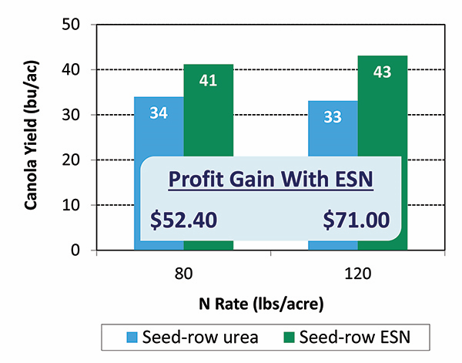
The study demonstrated ESN’s high degree of safety for seed-placed applications. The high degree of safety makes ESN the perfect nitrogen source for one-pass, direct-seed operations eliminating additional application and equipment costs. Yield increases observed with ESN translate to significant increases in canola profitability over that observed with urea.
- ESN and urea were placed in the seed-row at planting at rates of 80 and 120 lbs. N/acre.
- At 80 lbs. N/acre, ESN produced 7 bu/acre more yield and $52.40/ acre more profit.
- At 120 lbs. N/acre, ESN produced 10 bu/acre yield and $71.00/acre more profit.
Contact your local ESN representative if you’re ready for a seed-safe nitrogen source that will protect against loss.