

Managing Nitrogen in the Field – 4R Best Practices
Nitrogen can be a costly and difficult to manage nutrient in your fertilizer …
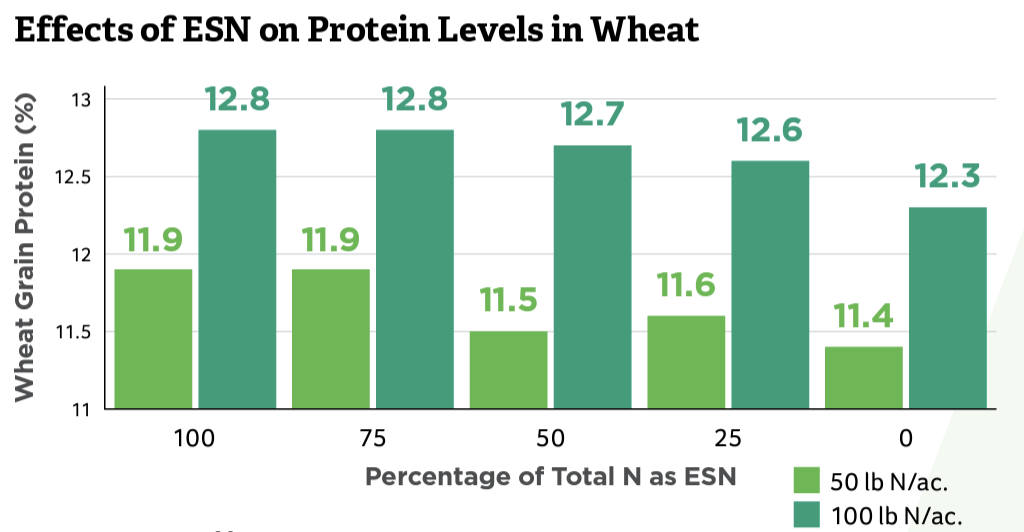
A four year Minnesota study demonstrates how ESN can increase protien levels in spring wheat. ESN protects nitrogen (N) from loss inside its unique protective coating and supplies N to the crop when it is needed. By supplying N to the crop later in the growing season, more N is available for protein production in the grain.
Wheat plants need N throughout the growing season. Most N uptake by a wheat plant takes place in the period of about 40-80 days after planting and continues up to 120 days after planting. ESN may be used to meet this season-long demand.
In this four year study, ESN incorporated 3 days prior to planting increased protein levels compared to urea. Protein levels in ESN treatments increased with higher percentages of ESN in the final blend and were demonstrated at both the 50 and 100 lb N/acre rate.
| Attachment | Size |
|---|---|
| Effects of ESN on Wheat Protein Levels | 253.4 kb |
Nitrogen can be a costly and difficult to manage nutrient in your fertilizer …

Efficient nitrogen (N) management is an important driver of yields and profitability. However, …

When you add nutrients to your soil, it’s not just your crops that …