
Testing for Nutrient Availability: The Value of Biological Soil Testing
We have all been there. Nutrients are applied, but crops aren’t performing the …
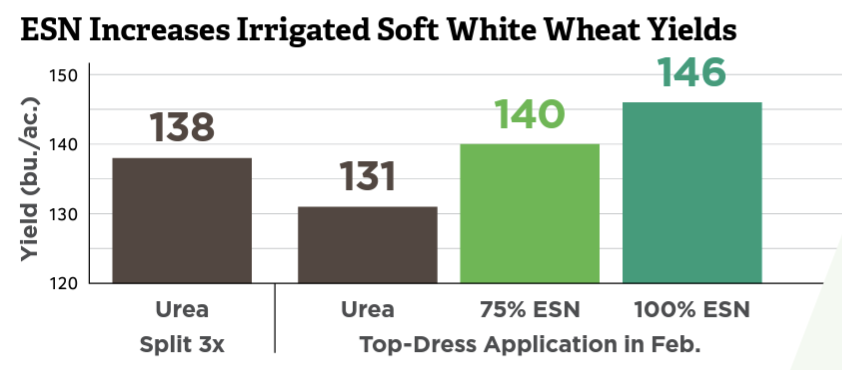
Trial was conducted at Hermiston, OR on sprinkler-irrigated soft-white winter wheat. Yields shown are averages of two N rates. Split urea application consisted of 50% of total N applied in February, 15% at flag-leaf emergence, and 35% at boot stage.
*Profit calculations assume wheat price of $5.00/bu; an ESN price difference of $0.20/lb N more than urea and application cost of $7/acre.
Research in Oregon demonstrates the advantage of ESN in irrigated, soft-white winter wheat. Irrigated wheat in the Pacific Northwest can produce very high yields but requires good nitrogen (N) management to achieve these yields. Conventional best management practices (BMPs) typically use multiple applications of conventional N fertilizers. These practices can improve N-use efficiency, but they incur additional costs and can be delayed by unfavorable weather or soil conditions.
A single ESN top-dress application in February was compared with top-dress urea applied in one or three applications. The ESN treatments produced greater yields than either of these conventional practices.
| Attachment | Size |
|---|---|
| ESN Increases Yields in Irrigated | 264.51 kb |
We have all been there. Nutrients are applied, but crops aren’t performing the …

Nitrogen is the most commonly applied nutrient in fertilizers around the world, playing …

Nitrogen (N) is the most important input in crop production systems around the …