Nitrogen Use Efficiency: What It Is and How It Works

Summary of what you'll find
Nitrogen (N) is the most important input in crop production systems around the world, but studies have shown that not all of the nitrogen we apply makes it into the crop.¹ Despite the incredible demand for nitrogen by the crop during the growing season, it is prone to loss to the environment through volatilization, denitrification or leaching. Thus, agronomists have placed increased attention on improving the amount of applied nitrogen that the crop can uptake and put to work, commonly referred to as nitrogen use efficiency (NUE).
NUE has emerged as an important way to assess the performance of nitrogen management plans. Simply put, it measures how effectively plants use the nitrogen applied through fertilizers to produce yield. A highly efficient nitrogen fertilizer program can enhance sustainability, protect the environment and improve farm gate ROI.
Routine NUE assessments help growers increase or maintain maximum yields while optimizing nitrogen fertilizer inputs and making the most of every dollar they invest.
What is nitrogen use efficiency?
Nitrogen use efficiency, or NUE, looks at how much of the nitrogen that goes onto our fields ends up being used by crops. There are several ways to measure crop response to nitrogen fertilizer applications.
Since NUE measurements were first introduced, authors have defined the term ‘crop productivity’ used in NUE calculations in a variety of ways. It can refer to the mass of the harvested crop (yield), the nitrogen content in harvested crop, the aboveground biomass of crops or the nitrogen content of aboveground biomass. The definition used depends on the specific NUE calculation. This article looks at three different ways to calculate NUE, based on different data inputs.
How is NUE measured?
There are various ways to define crop response, as discussed previously. Thus, there are several calculations that can be used to determine NUE. Don’t let that get in the way of trying out a NUE-based performance assessment this year. Calculating NUE usually depends on the availability of the information needed to run the equations. We walk through three possible approaches below.
Calculations one and two: start simple
Equation one
The simplest and most common method is to divide total yield (i.e., bushels per acre of corn) by the nitrogen applied (pounds of applied nitrogen fertilizer per acre). This approach is also called ‘Partial Factor Productivity’ (PFP).
The equation addresses the question of whether the cropping system is productive relative to its nitrogen application. To calculate PFP, use the following formula:
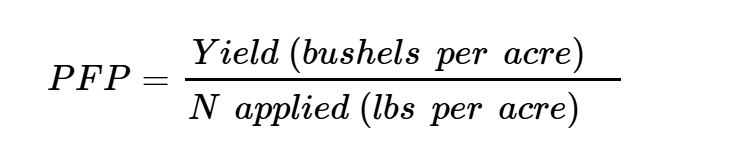
The higher the resulting number, the more yield you are producing per unit of applied nitrogen fertilizer.⁶ This method is commonly used on the farm as the information is readily available and easy to access (yield per acre and the pounds of nitrogen fertilizer applied per acre).²
Equation two
There are other simple interpretations of NUE, including Iowa State University’s definition, partial nitrogen balance (PNB). They determine a system’s NUE by evaluating the pounds of applied nitrogen fertilizer per acre divided by yield per acre (a flip of the previous equation):

This equation helps growers and agronomists address the question of how much nitrogen fertilizer is needed to produce a unit of yield, relative to county average benchmarks.
The information and exact equations (equation one or two) used to calculate NUE in the two previous examples are based on local preference, questions asked and if the measurements needed for the equation are readily available (i.e., yield data from the combine and the pounds of nitrogen applied per acre from the agronomist).
Calculation three: added complexity
The previous methods don’t account for the nitrogen already available in the soil.³
Calculating the NUE of a soil system can deliver a more accurate estimate by considering the link between crop and soil nitrogen and overall background soil fertility. This is called the agronomic efficiency (AE) of nitrogen. This method helps growers and agronomists determine whether the nitrogen applied improved productivity relative to the background soil nitrogen available. In other words, did the applied nitrogen fertilizer help improve yields relative to background rates (zero pounds of nitrogen applied per acre at checks) of nitrogen in the field?
It helps you understand how well your soil system naturally cycles nitrogen, through the use of zero applied nitrogen check strips, and provides insights on how applied nitrogen fertilizers help drive additional yields. As you might imagine, the equation requires a bit more planning and complexity relative to the first two that were described.
Agronomic efficiency can be calculated with the following equation:

*Note: Yield is usually expressed as bushels per acre (bu/ac) and applied nitrogen fertilizer is expressed in pounds per acre (lbs N/ac).
Higher AE means more efficient use of nitrogen relative to a field with a lower score managed under similar conditions.
High versus low NUE
While the interpretation of a specific result depends on the calculation used, a stronger NUE score generally means that a higher proportion of the applied nitrogen is used in the harvested product, indicating improved nitrogen use efficiency and fewer losses to the environment. A stronger NUE also generally indicates that the right rate, source, time and place are being used for applied nitrogen.⁶ See the link below for specifics on how to interpret your NUE score based on the choice of calculation.
Conversely, when NUE is low, it means the crop is not using the applied nitrogen to generate a harvestable product as it should. In this scenario, the risk of inefficient nitrogen uptake is high and losses to the environment may be elevated.
Agricultural universities publish in-depth guidelines for interpreting NUE scores based on the method of calculation used. Growers can use these guides to better understand their NUE and what management decisions can help them address low efficiency fields.
Why does NUE matter?
NUE has become an important element of sustainable crop production as the negative impacts of nitrogen loss are clearly demonstrated by lower yields on the farm and in the environment (i.e., green ponds in the summer). Optimizing NUE can help you reach yield goals, increase productivity, decrease impact on the environment and increase the efficiency of your overall fertilizer program by avoiding over or under applying nitrogen.
When fields are highly nitrogen efficient, they can improve grower ROI by maximizing returns on fertilizer investments, reducing negative environmental impacts and supporting long-term soil health by making the most of the nutrients you apply.
How can we improve NUE?
According to Iowa State University, rotating crops, improving soil drainage and applying fertilizer in the spring are the most effective management decisions that can improve NUE.⁵ Other management practices that can improve NUE include soil and tissue testing, earlier planting (when feasible), in-season fertilizer applications, the use of nitrogen stabilizers or enhanced-efficiency fertilizers and implementing the principles of 4R Nutrient Stewardship. Routinely measuring NUE after each harvest, on each field, can help provide insights on which part of the farm needs more attention with respect to promoting efficient fertilizer use.
Sustainable crop production and NUE
Focusing on NUE helps ensure every pound of nitrogen you apply works its hardest for you and your bottom line. By understanding where your nitrogen goes and how efficiently it’s used, you can make informed management decisions that maximize yield, minimize loss and protect the environment.
Learn more about optimizing nitrogen management with the following resources:
Improving Nitrogen Use Efficiency in Volatile Market Conditions
Managing Nitrogen in the Field – 4R Best Practices
Nitrogen Management: How Nitrogen is Lost and How to Protect It
What Value Do Enhanced-Efficiency Fertilizers Offer to Growers?
Sources:
¹Nitrogen use efficiency—a key to enhance crop productivity under a changing climate – PMC
²NUE-A-guide-to-conducting-your-own-assessment.pdf
³Frontiers | Nitrogen Use Efficiency Definitions of Today and Tomorrow
⁵Pounds of Nitrogen per Bushel of Corn – Benchmarking Farms Against Local Averages