
Testing for Nutrient Availability: The Value of Biological Soil Testing
We have all been there. Nutrients are applied, but crops aren’t performing the …
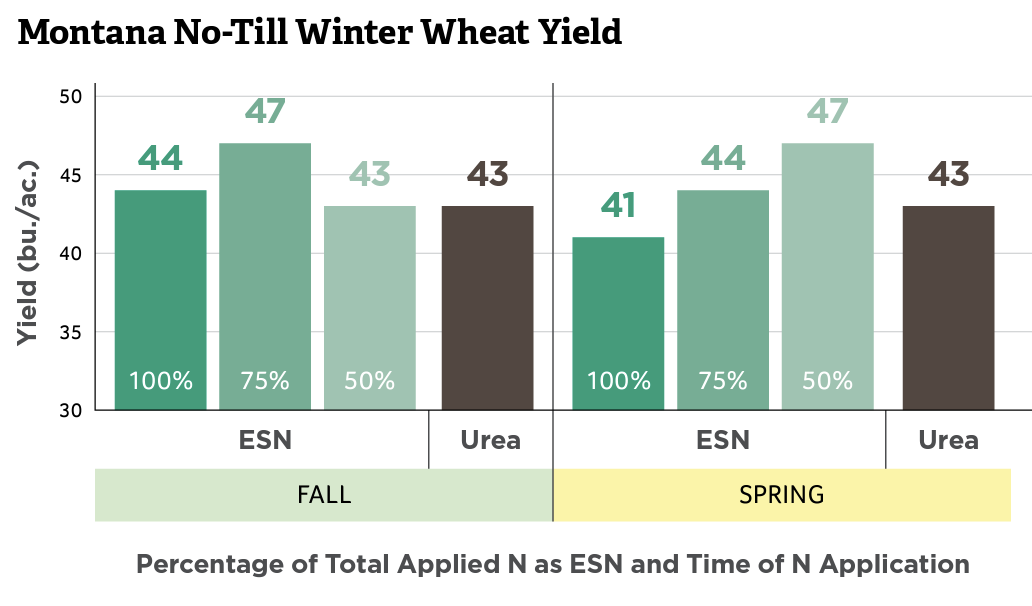
Source: Montana State Univ. at Mocassin, MT. Yields are means of two years. Nitrogen rate of 82 lbs N/acre is MSU recommended rate as determined by yield goal of 40 bu/acre and estimated N mineralization of 30 lbs N/acre. Net return calculation is based on 4 bu/acre yield difference, wheat price of $6/bu, and ESN-urea price difference of $0.20/lb N.
ESN can be an effective tool for nitrogen (N) management in no-till winter wheat in the Northern Great Plains. This Montana State University study demonstrated that ESN, broadcast either in fall or spring can out-perform conventional urea. ESN, urea, and different blends of ESN and urea were broadcast either in the fall at seeding (late Sept –early Oct) or in the spring at “green-up” (early April).
Optimum ESN blends in both fall and spring produced greater yields than urea applied at the same time.
| Attachment | Size |
|---|---|
| ESN Is The Smart Nitrogen For Montana Winter Wheat | 1.64 mb |
We have all been there. Nutrients are applied, but crops aren’t performing the …

Nitrogen is the most commonly applied nutrient in fertilizers around the world, playing …

Nitrogen (N) is the most important input in crop production systems around the …