
Testing for Nutrient Availability: The Value of Biological Soil Testing
We have all been there. Nutrients are applied, but crops aren’t performing the …
ESN Increases Dry Bean Yields
Research trials conducted in Southern Alberta by Alberta Agriculture and Rural Development scientists have shown that optimum bean production (as a row crop) occurs when soil test nitrogen (N) plus applied fertilizer N in the 0 – 12″ depth is between 80 and 100 lb N/acre. When grown as a solid seeded crop, soil N plus fertilizer N in the same test depth, should be between 100 and 120 lb N/acre to maximize production.
The difficulty is that dry beans are not good N “fixers”, and that readily available early season N is known to reduce nodule formation, and ultimately the plant’s own ability to make its own N. Past work in Manitoba with soybean (data not shown) showed that ESN application did not reduce nodule formation, nor affect soybean’s ability to fix its own N.
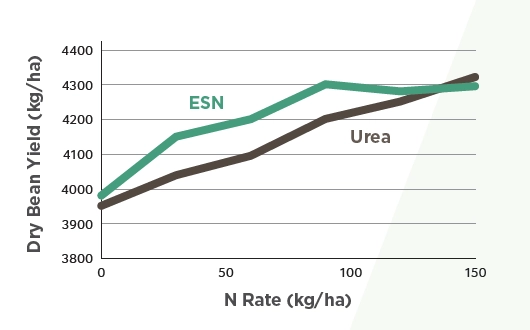
In this current study that compared ESN N and urea N, it is shown that ESN N provided a yield benefit over that of urea N, presumably because it does not “flood” the soil with early-season available N, and does not reduce nodule formation.
Additionally, when comparing the N response curves for ESN and urea – we see that ESN provides maximum yield at lower N application rates as compared to urea (i.e. 90 kg N/ha ESN-N versus 150 kg N/ha urea-N), and that ESN improves N use efficiency (NUE) at the lower, mid and plateau phases of the yield response curve.
This is what to expect of ESN – an enhanced efficiency N product that protects against N loss, while at the same time supplying plant available N. Increasing NUE means you can do more with less, or that you can produce more for the same application rate.
| Attachment | Size |
|---|---|
| ESN Is The Smart Nitrogen For Optimum Dry Bean Production | 671.35 kb |
We have all been there. Nutrients are applied, but crops aren’t performing the …

Nitrogen is the most commonly applied nutrient in fertilizers around the world, playing …

Nitrogen (N) is the most important input in crop production systems around the …