Improving Nitrogen Use Efficiency in Volatile Market Conditions

Maximizing profitability, minimizing environmental impact and increasing crop productivity is essential to a successful farming operation when markets are volatile. Protecting your nitrogen fertilizer investment and improving your crop’s uptake of applied nitrogen and the pounds of nitrogen per bushel (nitrogen use efficiency) is a key place to start.
When nitrogen is efficiently managed and used by crops, there are direct benefits to both the farmer and the environment. While 4R Nutrient Stewardship helps farmers consider the best timing, rate, source and placement of nitrogen to improve its efficiency, nitrogen efficiency can also be improved through different management practices. According to Iowa State University (ISU) Extension and Outreach, rotating crops, improving drainage, shifting from fall to spring fertilizer applications can improve NUE. Additionally, adding nitrogen stabilizer products or controlled release polymers can also improve nitrogen use efficiency in your field. These practices can help improve your crop’s uptake of applied nitrogen, resulting in less loss to the environment and an increase in yield.
Nitrogen use efficiency (NUE), as defined by ISU, measures the pounds of nitrogen applied on the field per bushel harvested (calculated by dividing applied nitrogen fertilizer rates with crop yield). Simply put, NUE helps farmers understand how much nitrogen is lost to the environment, how much nitrogen is used by the crop and how many pounds of nitrogen fertilizer are required to maximize yield for each bushel produced. As up to 60 percent of applied nitrogen can be lost to volatilization, denitrification and leaching, improving NUE ensures that the nitrogen you apply is taken up and used by your crop. NUE can be affected by unforeseen weather, crop genetics, soil type and overall nutrient management.
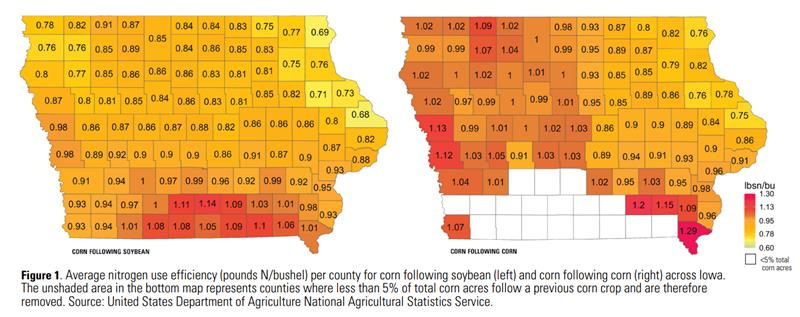
Farmers in Iowa who are looking to better understand their field’s NUE can reference ISU’s new benchmarks. Farmers can compare their fields to the new map—allowing them to benchmark their nitrogen use efficiency against counties across the state and identify management practices that work and practices that do not. The statewide average pounds N per bushel of corn is 0.88 for corn following soybean and 0.97 for corn following corn.
Using this calculation, some parallels can be drawn to the game of golf. The lower the NUE score, the more efficient your fertilizer inputs are being used by the crop.
Farmers who notice they need to improve their NUE can focus on controlling and improving planting dates, soil management and nitrogen management practices to ensure maximum efficiency.
The ISU Extension and Outreach program also provides farmers with a rule of thumb for nitrogen applications based on their recent findings. At harvest, the average bushel of corn contains approximately 0.55 pounds of nitrogen. Thus, we must apply at least 0.55 pounds of nitrogen per bushel to sustain nitrogen in our fields and continue to maximize yield. When looking at pounds N per bushel, ISU says that lower values indicate higher nitrogen use efficiency (see table below). Thus, the closer your own score is to 0/55 lbs. N/bu., the more efficient your system is and the more yield you are extracting from each pound applied N fertilizer. In comparison, higher values indicate poor nitrogen efficiency and the potential for nitrogen loss as applied nitrogen is less accessible to crops in the soil.

Increase Your NUE Score
Managing the efficiency of the nitrogen in your field is critical to maximizing yield, increasing profitability and improving overall sustainability. When the nitrogen you apply stays in your fields, and you apply the optimal amount needed for crop uptake and production, you have unlocked improvements in nitrogen efficiency.
4R Nutrient Stewardship is a great place to start when looking to enhance your field’s NUE. The 4Rs help farmers apply the right nutrient source at the right rate in the right place and at the right time. These practices ensure that the nitrogen you apply is most aligned with your field’s conditions, your crop’s needs and your soil’s nutrient bank. Farmers can evaluate and adjust the timing, placement and rate of nitrogen they apply to improve NUE (i.e., applying in the fall instead of spring, using banding instead of broadcast, decreasing input rates while using a rotational cropping system).
Farmers can also take a closer look at the nutrient source they apply. Enhanced-efficiency fertilizers (EEF) can help improve your field’s NUE by minimizing the loss mechanisms that conventional nitrogen fertilizers are prone to. Inhibitors and stabilizers or slow and controlled release fertilizers are EEFS that can change the performance of our nitrogen to ensure it is delivered directly to the crop. ESN is a great example of these products. ESN maximizes a field’s NUE by releasing nitrogen in response to soil temperature; ensuring that nitrogen is released based on the demands of your crops while reducing losses to the environment.
Curious about how you can improve nitrogen use efficiency in your field and better protect your fertilizer investment? Learn more about ESN (environmentally smart nitrogen) today or reach out to a rep in your area.
Sources:
Baum, M., Andersen, D., Archontoulis, S., & Castellano, M. (2024). Pounds of Nitrogen Per Bushel of Corn – Benchmarking Farms Against Local Averages. Iowa State University Extension and Outreach. https://store.extension.iastate.edu/Product/17043
Kramer, C. (2024). How Nitrogen-Efficient Do You Think Your Field Is? The Scoop. Farm Journal, Inc. https://www.thedailyscoop.com/news/retail-industry/how-nitrogen-efficient-do-you-think-your-field?mkt_tok=ODQzLVlHQi03OTMAAAGVDqJFtMF5rJlV-dfFAflPYLv4PNHlUnN9u8SgayqO8DebvgVxec1OJIHmUDZtrnB_7WXqWCpNJdLahmTvwtSzQrGN5cEhyxpFed6gmZHRvCpuB3O1tw
Additional Reading: